Notion Number Property: Currency, Percent, and Progress Bars
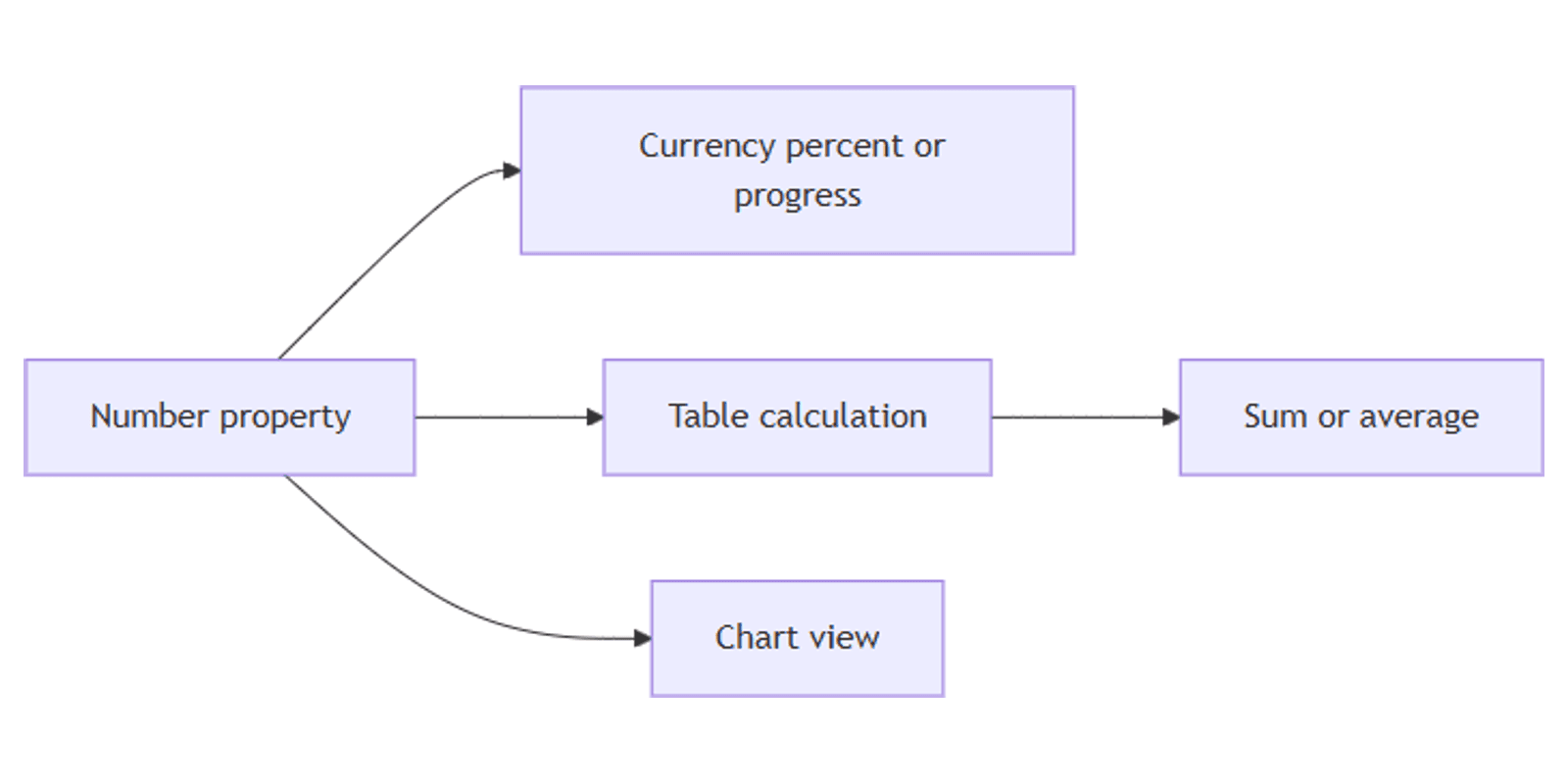
The Notion Number property stores amounts, quantities, scores, rates, and completion values in a database. Format one numeric field as a plain number, currency, percent, or visual progress bar without converting it to text.
This guide covers how to add and format a Number property, calculate Sum and Average in Table view, chart totals, and build CRM, budget, progress, and invoice workflows. See Notion's database properties help for the official property reference.
What is a Notion Number property?
A Number property accepts numeric values. Its format changes how those values are displayed, not the underlying purpose of each row.
| Format / display | Example use | Example display |
|---|---|---|
| Number | Inventory quantity | 250 |
| Number with commas | Large stock counts | 10,000 |
| Currency | CRM deal amount | $12,500 |
| Percent | Completion or conversion | 75% |
| Bar | Goal completion | Horizontal progress bar |
| Ring | Goal completion | Circular progress ring |
Use one consistent unit per property. Do not mix revenue, item counts, and percentages in the same column even though each is technically a number.
How to add and format a Number property
- Open a Notion database.
- Click + beside the rightmost property.
- Name the field, such as Amount, Quantity, Score, or Completion.
- Select Number as the property type.
- Enter numeric values in the rows.
To change the display:
- Open the Number property's menu.
- Choose Edit property.
- Open Number format.
- Select a plain number (with or without commas), currency, percent, or a visual display.
- For Bar or Ring, set Divide by to the maximum the progress is measured against (for example 100 for percent-style goals), pick a color, and optionally show number inside the visualization.
Currency formatting adds a symbol and readable separators. Percent formatting communicates a rate. Bar and Ring make values easier to scan when every row shares the same target scale.
Number vs Formula
A Number property is entered or updated directly. A Formula calculates its output from other properties.
| Number | Formula | |
|---|---|---|
| Value source | Manual entry, import, or automation | Expression using other fields |
| Best for | Amount, quantity, score, entered percent | Line total, margin, weighted score |
| Editable per row | Yes | No, edit the formula instead |
| Example | Unit price = 25 | Quantity multiplied by Unit price |
Store source data in Number properties. Use Formula when the number should always be derived.
Calculate totals in Table view
Notion Table view can calculate a Number column in its footer.
- Open a Table view.
- Move to the bottom of the Number column.
- Click Calculate.
- Choose an option such as Sum, Average, Minimum, Maximum, or a count.
| Calculation | Useful question |
|---|---|
| Sum | What is the total pipeline or invoice value? |
| Average | What is the average score or order amount? |
| Minimum | Which row has the lowest quantity? |
| Maximum | What is the largest deal? |
| Count values | How many rows have a number entered? |
Footer calculations follow the rows visible in that view. A filtered sales view can therefore sum open opportunities without including closed-lost deals.
Filter, sort, and chart numbers
Use database filtering to focus numeric data:
- Amount is greater than 10,000 for high-value deals.
- Quantity is less than 10 for low-stock inventory.
- Score is at least 80 for qualified records.
- Completion is less than 100% for unfinished projects.
Sort descending to surface the largest amounts or highest scores. Sort ascending to find low stock or the smallest balances.
For a visual summary, add a Chart view, choose a suitable category, and use the Number property as the value. Charts are useful for totals by owner, stage, month, or category; Table footers remain better for a quick exact total.
| Goal | Best tool |
|---|---|
| Exact total at the bottom of a list | Table calculation |
| Compare totals across categories | Chart view |
| Find values above or below a threshold | Filter |
| Rank rows by value | Sort |
Practical Number property workflows
CRM deal Amount with Sum
- Add Amount as a Number property and choose the required currency format.
- Add Stage, Owner, and Expected close properties.
- Filter out closed-lost deals.
- Select Sum in the Amount column footer.
- Add a Chart grouped by Stage or Owner for a pipeline overview.
Start with the CRM Dashboard if you want a ready-made workspace.
Budget tracker
- Add Budget and Actual as currency Number properties.
- Add Category and Month.
- Sum Actual in monthly filtered views.
- Add a Formula for variance when you need Actual minus Budget.
- Sort by Actual descending to review the biggest expenses first.
Completion percent with a progress bar
- Add Completion as a Number property.
- Choose percent formatting or a progress display.
- Enter values consistently according to the selected format and target.
- Filter below complete to create an active-work view.
- Show the numeric value with the bar when exact progress matters.
Use manual completion for estimates entered by a project owner. Use a Formula when progress should be computed from completed and total work.
Invoice totals
- Add Quantity and Unit price as Number properties.
- Add a Formula that multiplies Quantity by Unit price for each line total.
- Format Unit price and the Formula result as currency.
- Use Sum in the line-total footer for the invoice total.
- Filter by Client or Invoice ID when several invoices share one database.
Reusable finance and operations layouts are also available in the Notion Templates Bundle.
Inventory quantity and reorder view
- Add Quantity and Reorder level as Number properties.
- Sort Quantity ascending.
- Filter records below the team's reorder threshold.
- Use a Formula when the threshold differs by product.
Number property tips
- Put the unit in the name when it is not obvious, such as Weight kg or Duration minutes.
- Choose one currency per property to prevent misleading footer totals.
- Keep raw values numeric so Notion can sort, filter, calculate, and chart them.
- Use Formula for derived values instead of manually maintaining duplicate totals.
- Filter before calculating when the footer should represent a segment rather than all rows.
FAQ
How do I format a Number property as currency?
Open the property's options, select Number format, and choose the required currency. Existing numeric values stay numeric and display with that currency format.
Can a Notion Number property show a progress bar?
Yes. Open Edit property → Number format and choose Bar or Ring. Set Divide by to the target maximum, optionally enable show number, and pick a color.
How do I sum a Number column in Notion?
Use a Table view, click Calculate at the bottom of the Number column, and choose Sum. The result reflects rows visible in that view.
Should invoice totals use Number or Formula?
Enter source values such as Quantity and Unit price as Number properties. Calculate each line total with a Formula, then use a Table footer Sum for the visible invoice total.
Conclusion
The Notion Number property keeps quantitative data usable: format amounts as currency, rates as percent, and goals as progress bars; then filter, sort, calculate, and chart the values. Use Table view for exact Sum and Average calculations and Chart view for comparisons.
When a value should be computed rather than entered, move the logic to Notion Formulas. For a broader reporting workspace, combine number fields with database views and filtered dashboards.
Notion Templates
Start Selling Notion Templates - Start Now!