Notion Date Property: Deadlines, Ranges, and Reminders
The Notion Date property stores deadlines, appointments, publish dates, and project ranges in a database. A date can be one day or a start-and-end range, with an optional time for work that must happen at an exact hour.
This guide shows how to add a Date property, configure ranges and reminders, filter relative dates, and use dates in Calendar and Timeline views. See Notion's database properties help for the official property reference.
What is a Notion Date property?
A Date property is a database field that accepts a single date or date range. You can add a time, choose a display format and timezone, and attach a reminder.
| Setting | What it controls | Example |
|---|---|---|
| Date | One deadline or event date | July 22, 2026 |
| End date | Turns the value into a range | July 22–24 |
| Include time | Adds an exact start time | July 22 at 2:00 PM |
| Date format & timezone | Controls display and timezone | YYYY/MM/DD, Europe/Belgrade |
| Remind | Sends a notification relative to the date | 1 day before |
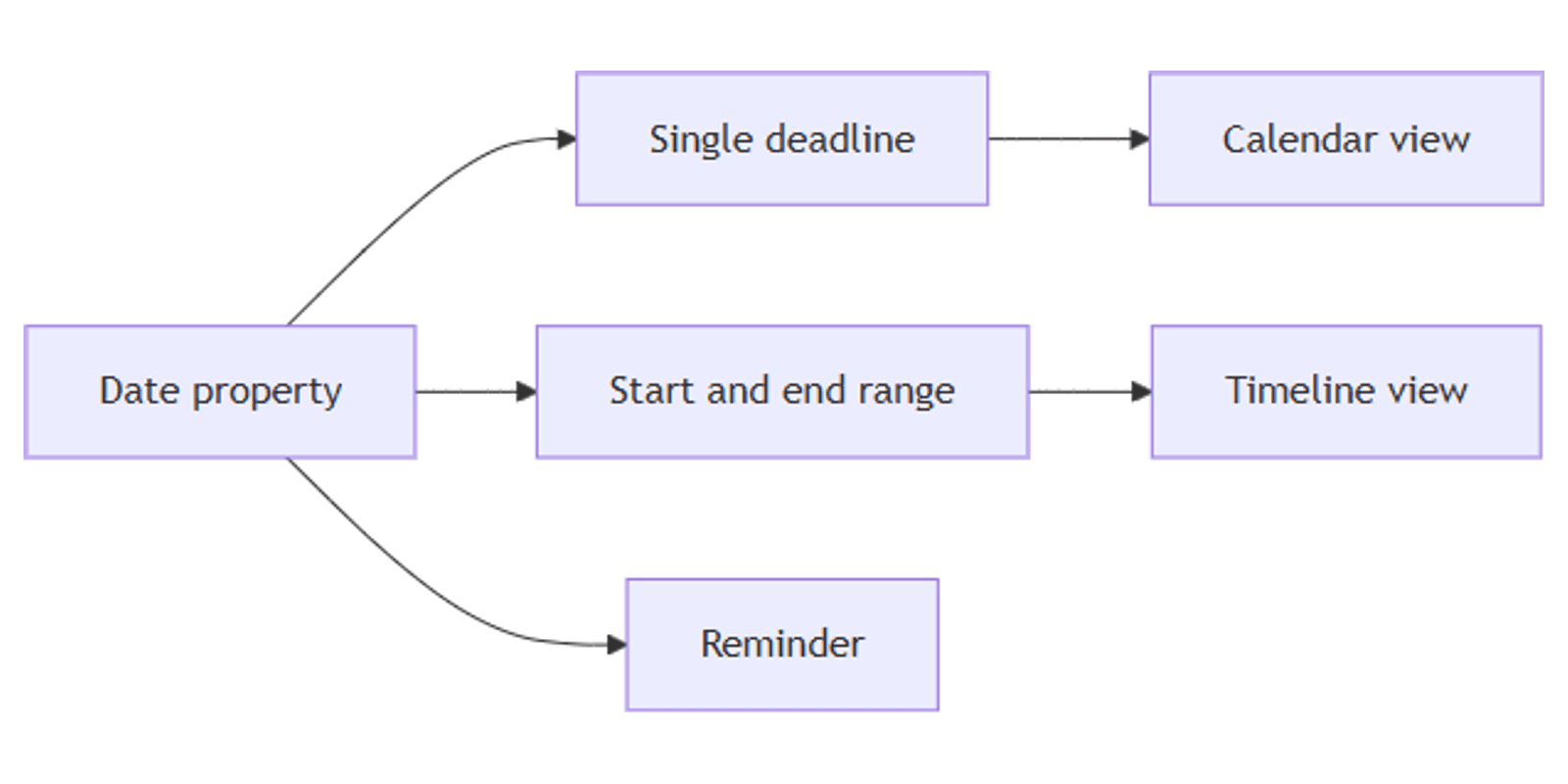
Use a single date for a deadline. Turn on End date when an item spans multiple days or needs a start and finish on a Timeline.
How to add and configure a Date property
- Open a Notion database.
- Click + beside the rightmost property, or open an existing property menu.
- Name the property, such as Due, Publish date, or Close date.
- Select Date as the property type.
- Click a row's Date cell and choose a date in the picker.
Add an end date
- Open the Date cell.
- Turn on End date.
- Choose the finishing date.
The database now stores a range. This is useful for campaigns, trips, events, and project phases.
Include an exact time
- Open the Date cell.
- Turn on Include time.
- Set the time for the start and, when applicable, the end.
- Open Date format & timezone if the display or timezone needs changing.
Keep all-day tasks date-only. Add time for meetings, launches, calls, and other appointments where the hour matters.
Set reminders from a Date property
Open the Date cell and choose Remind, then select when Notion should notify you. The available choices depend on whether the value includes a time.
You can also type an @remind mention in a page or comment. Use the Date property's reminder when the notification belongs to a structured database deadline; use @remind for a reminder embedded in notes or discussion.
| Method | Best for |
|---|---|
| Date property reminder | Task, event, or CRM deadline stored in a database |
@remind mention | A reminder inside page text, a comment, or a discussion |
Power Calendar and Timeline views
A Date property gives Notion's time-based views their schedule.
Calendar view
- Add a Calendar view.
- Open view settings and select the Date property to use.
- Drag cards between days to reschedule them.
A database needs a Date property before its items can be placed meaningfully on a calendar.
Timeline view
- Add a Timeline view.
- Select a Date property with start and end dates.
- Drag either edge of an item to adjust its range.
Timeline is strongest for project phases and campaigns because ranges show duration, overlap, and handoffs.
| View | Best date shape | Best use |
|---|---|---|
| Calendar | Single date | Deadlines, events, publish dates |
| Timeline | Date range | Projects, campaigns, multi-day work |
| Table | Either | Editing, filtering, and auditing dates |
Filter relative dates
Database filters can keep a view current without entering a fixed calendar date. Common relative filters include:
- Due is Today for a daily task list.
- Publish date is This week for an editorial schedule.
- Close date is Past for overdue CRM follow-up.
- Due is before Today plus Status is not Done for overdue tasks.
Add conditional color to the last view so overdue rows or cards stand out. Keep the rule tied to both the date and completion state so finished work is not marked late.
Date vs Created time vs Last edited time
Date is manually scheduled. Created time and Last edited time are generated automatically by Notion.
| Property | How it changes | Best for |
|---|---|---|
| Date | A person or automation sets it | Due dates, events, planned ranges |
| Created time | Set when the page is created | Intake and record age |
| Last edited time | Updates after edits | Freshness and review queues |
Do not use Created time as a deadline: it records when the item entered Notion, not when work is due. See Created time and Last edited time for timestamp workflows.
Practical Date property workflows
Task due dates
- Add Due as a Date property.
- Add a Status property.
- Filter Due is on or before Today and Status is not Done.
- Sort Due ascending and color overdue work red.
- Add a reminder to high-priority deadlines.
Content publish calendar
- Add Publish date, Status, Channel, and Owner.
- Create Calendar and Table views using Publish date.
- Filter a planning view to This week.
- Move a card on the Calendar when the schedule changes.
Plan posts with the Social Media Multi-Platform Content Planner.
CRM close dates
- Add Expected close as a Date property.
- Filter open deals where Expected close is Past.
- Sort by expected close, then by amount.
- Review overdue opportunities in a weekly sales view.
Project ranges on Timeline
- Add Project dates and turn on End date for each project.
- Create a Timeline using Project dates.
- Group by team or project status.
- Adjust ranges as scope changes and inspect overlaps before assigning work.
Date property tips
- Name dates by intent - Due, Publish date, and Renewal date are clearer than Date.
- Use one timezone policy for distributed teams and check it before timed launches.
- Reserve ranges for duration rather than adding separate start and end properties by default.
- Filter with relative dates so saved views stay useful next week.
- Add times only when needed to keep all-day work easy to scan.
FAQ
How do I add an end date in Notion?
Open the Date value, turn on End date, and select the finishing date. The value becomes a date range that can span one or more days.
What does Include time do?
Include time adds an exact hour and minute to the date. Use it for meetings, launches, and appointments; leave it off for all-day deadlines.
Does a Notion calendar need a Date property?
Yes. A Calendar view needs a Date property to place database items on days. Select the intended Date property in the view settings if the database contains more than one.
Can a Date property send reminders?
Yes. Open the Date value and choose Remind. For reminders written directly in page content or comments, use an @remind mention.
Conclusion
The Notion Date property turns database items into a schedule: set one deadline or an end-dated range, include time when precision matters, add reminders, and filter Today, This week, or Past. Use Calendar view for date-based planning and Timeline view for duration.
Next, build an overdue view with database filtering, highlight late work with conditional color, and use Created time and Last edited time only for automatic timestamps.
Notion Templates
Start Selling Notion Templates - Start Now!